| 26. 11. 2026 19:00 p.m. |
| 90 minut |
| Vesmír, Ostrava |
| from 480 CZK |
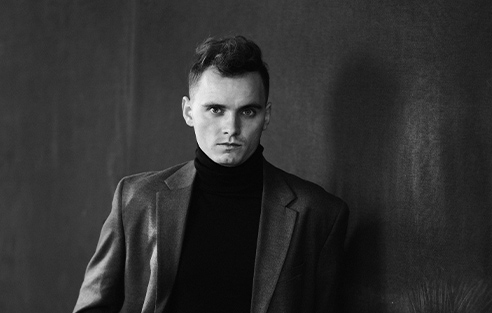
A2 Moser Plays Elgar
CHANGE OF CONDUCTOR, SOLOIST AND PROGRAMME
We would like to inform our audience of a change of conductor, soloist and programme for this concert. The Janáček Philharmonic Ostrava will now be conducted by Paweł Kapuła, and Julian Steckel will perform the solo part in place of the originally announced Johannes Moser. Edward Elgar’s Cello Concerto in E minor remains unchanged from the originally announced programme. The concert will also feature Beethoven’s overture to Egmont and his Symphony No. 2 in D major.
Thank you for your understanding.
Egmont, Overture / 9′

In 1789, Johann Wolfgang Goethe’s tragedy Egmont, based on historical events, was first performed in Mainz. Its title character, Count Lamoral van Egmont (1522–1568), lived during the conflict between the Netherlands and Spain under the rule of Philip II. Accused of treason against the Spanish king, he was eventually executed.
Goethe took considerable liberties with the historical narrative, but the play resonated with the turbulent atmosphere of the French Revolution and the Napoleonic Wars. In May 1809, French troops occupied Vienna, and in July Napoleon emerged victorious at the Battle of Wagram. Nevertheless, the management of Vienna’s Court Theatre decided to stage two plays intended to inspire patriotic sentiment: Schiller’s William Tell and Goethe’s Egmont.
The music for Schiller’s play was composed by Vojtěch Jírovec, while Ludwig van Beethoven (1770–1827), a great admirer of Goethe, undertook the music for Egmont. In addition to the overture, songs, entr’actes and finale, Beethoven provided music for key dramatic moments, unifying the entire work through thematic and motivic development.
The premiere on 24 May 1810 took place without Beethoven’s music, as the composer had not completed it in time. His score was first heard at the fourth performance on 15 June. The overture subsequently established itself as an independent concert work. Its dramatic progression culminates in a concluding coda symbolising the prophecy of eventual victory.
Cello Concerto in E minor, Op. 85 / 30′
The English composer Edward Elgar (1857–1934) is said to have contemplated writing a cello concerto for many years, although he did not begin composing it until 1919. Largely self-taught as a composer, Elgar gradually established himself as one of the most important figures in English music.
His output includes numerous vocal, chamber, orchestral and stage works. Among his best-known compositions are the Serenade for Strings, the Enigma Variations, the oratorio The Dream of Gerontius and the Pomp and Circumstance marches. He received numerous honours, including the Order of Merit and a knighthood.
The Cello Concerto in E minor, Op. 85, is one of his two concertos for solo instrument and orchestra, alongside his Violin Concerto. The first movement opens with a recitative for solo cello, answered by the wind instruments. The principal theme is then taken up by the soloist and developed through a series of transformations.
The second movement is notable for its use of pizzicato, while the slow third movement gives the soloist ample opportunity to explore lyrical expression and cantabile playing. The final movement is characterised by shifting tempos and expressive contrasts.
The concerto was premiered on 27 October 1919 by the London Symphony Orchestra, with cellist Felix Salmond as soloist and Elgar conducting. However, the first performance did not meet the composer’s expectations, reportedly because the orchestra had not been adequately prepared.
Over time, the work found its place in the repertoire of the world’s leading cellists. One of its most celebrated interpreters was Jacqueline du Pré, whose 1965 recording with the London Symphony Orchestra under Sir John Barbirolli became legendary. Today, Elgar’s concerto is among the most frequently performed works in the cello repertoire.
Symphony No. 2 in D major, Op. 36 / 32′
Ludwig van Beethoven worked on his Symphony No. 2 in D major, Op. 36, between 1800 and 1802. During this period, his musical language was developing rapidly, and the composer was gradually pushing beyond the boundaries of the Classical symphonic style.
The symphony was first performed on 5 April 1803 at Vienna’s Theater an der Wien, at a concert that also included the oratorio Christ on the Mount of Olives, Beethoven’s First Symphony and his Piano Concerto No. 3.
Contemporary accounts suggest that the exceptionally long programme and an insufficiently rehearsed orchestra affected the quality of the performance. Nevertheless, Beethoven’s pursuit of new expressive possibilities, greater dramatic intensity and richer orchestration was already apparent.
Following a slow introduction, the first movement develops an energetic theme introduced by the lower strings. The second movement creates a poetic and lyrical atmosphere in which some listeners have discerned an anticipation of Franz Schubert’s musical language.
The third movement takes the form of a characteristically Beethovenian scherzo, marked by striking dynamic contrasts and changes of key. The finale is full of abrupt entries, accents, trills and extraordinary energy. It was precisely this innovative character that led some contemporary critics to describe the symphony as “bizarre and wild”.
Programme notes: Vlasta Reittererová
Julian STECKEL – cello
German cellist Julian Steckel is among those performers who combine effortless technique with an extraordinary openness of expression. He regards music as a living organism and seeks the inner relationships that hold a composition together. “As a performer, I increasingly trust my inner world and allow the audience to enter it. It is a kind of vulnerability that makes you stronger,” he says. His playing is praised for its energy, naturalness and ability to convey both the architecture of a work and its emotional core.
A decisive boost to his solo career came with his victory at the prestigious ARD International Music Competition in Munich in 2010. Since then, he has performed with orchestras including the Leipzig Gewandhaus Orchestra, Bavarian Radio Symphony Orchestra, Munich Philharmonic, Royal Philharmonic Orchestra, Orchestre de Paris, Rotterdam Philharmonic Orchestra, Israel Philharmonic Orchestra and Tokyo’s Yomiuri Nippon Symphony Orchestra. He has collaborated with conductors such as Iván Fischer, Christoph Eschenbach, Sir Roger Norrington, Nicholas Collon, Jakub Hrůša, Fabien Gabel, John Storgårds, Lahav Shani, Gustavo Gimeno, Katharina Wincor and Daniele Rustioni.
In recent seasons, he has appeared at the opening of the Dvořák Prague Festival with the Bamberg Symphony and Jakub Hrůša, made his debut with the Royal Stockholm Philharmonic Orchestra and performed Richard Strauss’s symphonic poem Don Quixote in Japan. Other projects have taken him to the hr-Sinfonieorchester for Shostakovich’s First Cello Concerto, the Dallas Symphony Orchestra and Tonkünstler-Orchester Niederösterreich for Dvořák’s Cello Concerto, the Bournemouth Symphony Orchestra for Haydn, and the Orchestre symphonique de Québec for Friedrich Gulda’s Cello Concerto. In China, he has also performed the complete Bach suites for solo cello.
Chamber music remains an essential source of inspiration for him and a natural setting for musical dialogue. His chamber music partners have included Janine Jansen, Christian Tetzlaff, Antje Weithaas, Renaud Capuçon, Veronika Eberle, Vilde Frang, Karen Gomyo, Antoine Tamestit, Lars Vogt, Elisabeth Leonskaja, Paul Rivinius, Denis Kozhukhin and the Modigliani, Armida and Ébène string quartets. He regularly participates in major chamber music festivals and pursues his own projects, combining long-standing artistic partnerships with new programming ideas.
Julian Steckel grew up in a musical family. He studied with Ulrich Voss, Gustav Rivinius, Boris Pergamenschikow, Heinrich Schiff and Antje Weithaas. He considers it fundamental to recognise that ease and simplicity do not arise by chance, but through attentive listening, thoughtful work and precise awareness of every gesture. Alongside his concert career, he is deeply committed to teaching. He is Professor of Cello at the University of Music and Performing Arts Munich, encouraging his students to develop their own sound, expression and artistic identity.
His discography spans a wide range of music, from the Classical repertoire to works of the twentieth century. His recordings include cello concertos by Carl Philipp Emanuel Bach, concertante works by Erich Wolfgang Korngold, Ernest Bloch and Berthold Goldschmidt, sonatas by Sergei Rachmaninoff and Sergei Prokofiev, French sonatas and Zoltán Kodály’s Sonata for Solo Cello. He has collaborated with pianist Paul Rivinius on numerous recordings, while his chamber music projects also document his partnerships with Antje Weithaas and other leading performers.
He plays two cellos made in Cremona: one by Francesco Rugeri in 1695 and the other by Andrea Guarneri in 1685. When not performing, he lives in Munich.
Janáček Philharmonic Ostrava
Paweł KAPUŁA – conductor
Polish conductor Paweł Kapuła is one of the most distinctive figures of the younger generation of conductors. He is highly regarded for his mature interpretations of a broad symphonic repertoire, precise technique and energetic yet thoughtful approach to the score. He first came to wider attention in 2016, when he stepped in at short notice for Stanisław Skrowaczewski at the Warsaw National Philharmonic. Following his successful debut, he was described as “one of the great hopes of Polish conducting” and subsequently established collaborations with leading orchestras in Poland and abroad.
In September 2026, he made his debut at the BBC Proms at London’s Royal Albert Hall, conducting the BBC Scottish Symphony Orchestra. During the 2026/2027 season, he is also appearing with the Gulbenkian Orchestra in Lisbon, Symphoniker Hamburg, Copenhagen Phil, Leipzig’s MDR-Sinfonieorchester, the Danish Chamber Orchestra, Deutsche Staatsphilharmonie Rheinland-Pfalz and the Polish Baltic Philharmonic in Gdańsk. In March 2026, he performed alongside Martha Argerich at Hamburg’s Laeiszhalle in Prokofiev’s Piano Concerto No. 3.
In previous seasons, he has collaborated with the NDR Radiophilharmonie Hannover, Bremer Philharmoniker, Philharmonisches Staatsorchester Mainz, Japan Philharmonic Orchestra at Tokyo’s Suntory Hall, orchestras in Xi’an and Guiyang in China, Ulster Orchestra, Georgisches Kammerorchester Ingolstadt, Württembergische Philharmonie Reutlingen, opera orchestras in Oslo and Gothenburg, Sinfonieorchester Basel, Meininger Hofkapelle and Robert-Schumann-Philharmonie Chemnitz. He has also performed with Romanian orchestras in Sibiu and Cluj, as well as with the Janáček Philharmonic Ostrava.
Since 2021, he has served as Principal Guest Conductor of the Ignacy Jan Paderewski Pomeranian Philharmonic Symphony Orchestra in Bydgoszcz. In Poland, he also works regularly with the Warsaw National Philharmonic, the Polish National Radio Symphony Orchestra in Katowice, Sinfonia Varsovia, Sinfonia Iuventus, the Polish Radio Orchestra in Warsaw, the NFM Wrocław Philharmonic and other Polish ensembles.
His discography includes a complete recording of Beethoven’s piano concertos with the Prague Philharmonic Orchestra and American pianist Reed Tetzloff, as well as an album with Sinfonia Varsovia. He maintains a long-standing collaboration with the Polish Radio Orchestra in Warsaw and participates in recordings of works by lesser-known Polish composers.
He studied conducting with Tadeusz Strugała and Stanisław Krawczyński at the Krzysztof Penderecki Academy of Music in Kraków. He gained further experience as assistant to Jacek Kaspszyk at the Warsaw National Philharmonic and to Andrzej Boreyko at the Belgian National Orchestra. He also holds a degree in musicology from the Jagiellonian University in Kraków.

Made by