A4 Sibelius’ First
A concert of fresh American rhythms and Nordic romanticism awaits under the baton of Canadian conductor Tania Miller. From the American continent come Copland’s celebrated Appalachian Spring and his Clarinet Concerto, performed by Pablo Barragán. The second half of the evening will be filled with the power, beauty, and lyricism of the Finnish landscape in Jean Sibelius’s First Symphony.
PROGRAMME
Aaron Copland
Appalachian Spring, orchestral suite from the ballet (25’)
Aaron Copland
Concerto for Clarinet and Orchestra (17’)
Slowly and expressively. Cadenza
Rather fast
/intermission/
Jean Sibelius
Symphony No. 1 in E minor, Op. 39 (38’)
Andante, ma non troppo. Allegro energico
Andante (ma non troppo lento)
Scherzo: Allegro
Finale: Andante. Allegro molto. Andante assai. Allegro molto come prima. Andante (ma non troppo)
PERFORMERS
Pablo Barragán – clarinet
Janáček Philharmonic Ostrava
Tania Miller – conductor
During his more than fifty-year compositional career, Aaron Copland (1900–1990) established himself as one of the most highly regarded and best-known American composers of the 20th century. He grew up in Brooklyn, New York, as the youngest of five children. From an early age he longed to learn the piano, but had to make do with only modest lessons from one of his sisters. At the age of fifteen, Copland decided to devote himself to music professionally. During the first years of his musical career, he experienced a number of setbacks, and Copland’s first composition teacher, Rubin Goldmark, considered his modernist chords to be wrong notes. It was only during his studies in Paris, where he travelled in 1920, that Copland found understanding for his avant-garde orientation, namely in the person of the famed Paris Conservatoire teacher Nadia Boulanger. “It was wonderful for me to find a teacher with such openness of mind who at the same time had firm ideas about what was right and what was wrong in music. The confidence she placed in my talent, and her belief in me, were at the very least flattering, and even more than that—they were crucial to my development at that stage of my career,” the composer later recalled of her influence. After three years, Copland returned from Europe to the United States, where further disappointments awaited his compositional efforts. He therefore resolved to content himself with work as a pianist in one of the hotels in Pennsylvania, and in his spare time worked on his First Symphony. When the work was to receive its premiere in 1925 by the New York Symphony Orchestra, conductor Walter Damrosch assessed Copland’s composition with the words that “if a young man of twenty-five can write a symphony like that, in five years he will be ready to commit murder.” A balm for the composer’s soul may have been the positive reception of his jazz-influenced Music for the Theatre a few months later in Boston under Serge Koussevitzky, which encouraged him to continue experimenting with jazz. From 1936 onward, he substantially transformed his style and drew strong inspiration from the folk music of rural America.
The ballet Appalachian Spring ranks among Copland’s best-known compositions and even earned the composer the Pulitzer Prize in 1945. The work was written in 1943 and 1944 for Martha Graham and her dance company, which gave its staged premiere on 30 October 1944 in the Coolidge Auditorium of the Library of Congress in Washington, D.C. Appalachian Spring completes a loose ballet trilogy inspired by folk dance music and the spirit of the American Wild West. The trilogy began in 1938 with Billy the Kid and continued with Rodeo in 1942. In June 1943, Copland began working in Hollywood on Martha Graham’s as-yet untitled scenario, and completed the ballet a year later in Cambridge, Massachusetts. “After Martha sent me her first rough sketch, I knew immediately what I had to work with—namely, something to do with the pioneer American spirit, with youth and spring, with optimism and hope,” Copland later wrote. The title Appalachian Spring was taken by Graham from a poem by the American writer Hart Crane, though not the libretto itself, which depicts a wedding celebration on a Pennsylvania farm at the beginning of the 20th century. At its premiere, Copland’s work was immediately understood by audiences as a reflection of national identity, hope, and fulfilment in the difficult days of the Second World War. The score was originally written for a chamber ensemble of 13 instruments only. In the summer of 1945, however, Copland assembled from the ballet music a suite arranged for large orchestra. It was first performed on 28 February 1946 by the Los Angeles Philharmonic under Alfred Wallenstein.
The second half of the 1940s brought the definitive end in the United States of the celebrated era of swing and large big bands. Some jazz musicians turned toward chamber bebop, while others saw the future of jazz in its fusion with classical music. Just as the famous swing clarinettist Woody Herman had asked Igor Stravinsky to write Ebony Concerto for him, so too his equally celebrated colleague Benny Goodman, often referred to as the “King of Swing,” commissioned a new work from an equally distinguished composer—Aaron Copland. Goodman asked Copland to write a Clarinet Concerto in 1947, and the composer completed the work in the autumn of 1948, shortly after returning from a tour of Latin American countries. The result was a two-movement concerto whose technical demands reflected Goodman’s wide range and secure command of the clarinet’s high register. The first movement ranks among Copland’s most lyrical and melodic compositions; the second unfolds in a distinctly jazz spirit, enriched by Latin American rhythms. After becoming acquainted with the score, however, Benny Goodman hesitated to perform the work because of its difficulty and urged the composer to simplify certain passages. Goodman did not premiere the concerto until 1950. This took place on 6 November in New York with the NBC Symphony Orchestra and the Hungarian-American conductor Fritz Reiner.
Although the composer Jean Sibelius (1865–1957) ranks among Finland’s national heroes and the creators of Finnish national music, he only began learning Finnish at the age of eleven. The family into which he was born in the provincial inland Finnish town of Hämeenlinna preferred Swedish for everyday communication. During his grammar-school years, Sibelius fell in love with the verses of the Nordic national epic Kalevala, and he also grew deeply attached to the Finnish landscape of endless forests and vast lakes. At an early age he also showed promise as both composer and violinist. In 1885 he enrolled as a law student at the University of Helsinki, but soon transferred to the Helsinki Music Institute, where between 1885 and 1889 he prepared for a career as a violin virtuoso. However, he went through a crisis of self-confidence and abandoned the idea of a virtuoso career, reproaching himself for it for a long time. He ultimately chose the path of a composer. Sibelius was first introduced to the craft of composition in Helsinki by Martin Wegelius, but he gained a broader artistic outlook only during his studies in Berlin with Albert Becker in 1889–1890 and in Vienna with Robert Fuchs and Karl Goldmark in 1890–1891. There Sibelius became intimately acquainted with contemporary musical currents, and in Vienna the first ideas also emerged for the large-scale programmatic symphony Kullervo for soloists, male choir, and large orchestra, completed in 1892. In the following years Sibelius studied Finnish folk music in depth, and through a number of orchestral works, including the Lemminkäinen Suite and the tone poems En Saga and Finlandia, he built his own symphonic language.
When Sibelius began work on his First Symphony in 1898, he was no longer an inexperienced composer, but could rely on solid musical foundations and thorough creative knowledge. Unlike his earlier symphonic works, Sibelius’s First Symphony does not draw its programme from Finnish myths and sagas, but is a purely personal confession embodied in an absolute musical form. In the 1890s Sibelius had the opportunity to become acquainted with the great symphonies of Pyotr Ilyich Tchaikovsky, which made a powerful impression on him and represent the clearest source of inspiration for this work. Although the influence of the Russian neo-Romantics is indeed strong in the First Symphony, Sibelius’s unique artistic personality also asserts itself with equal force. And this is true from the very beginning. The long, reflective clarinet solo over the soft tremolo of the timpani—the voice of solitary and untamed nature—constitutes a truly unconventional opening for its time. After the premiere, which took place on 26 April 1899 performed by the Helsinki Philharmonic Society under the composer’s baton, Sibelius substantially revised his First Symphony. In this revised form, it soon achieved success on major European stages—in Stockholm, Christiania (as the Norwegian capital Oslo was then called), Hamburg, Amsterdam, and even at the Paris World Exposition in 1900.
“Tonight Pablo Barragán cast a spell over the audience. Quite apart from the perfection of his playing in every respect, it was above all his deeply expressive tone that held listeners in breathless suspense.” (Westdeutsche Zeitung)
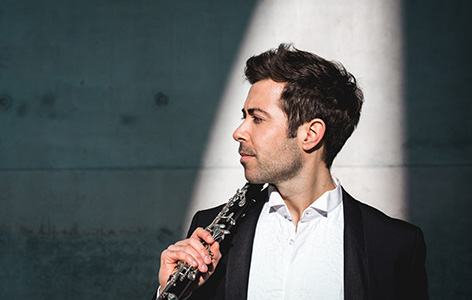
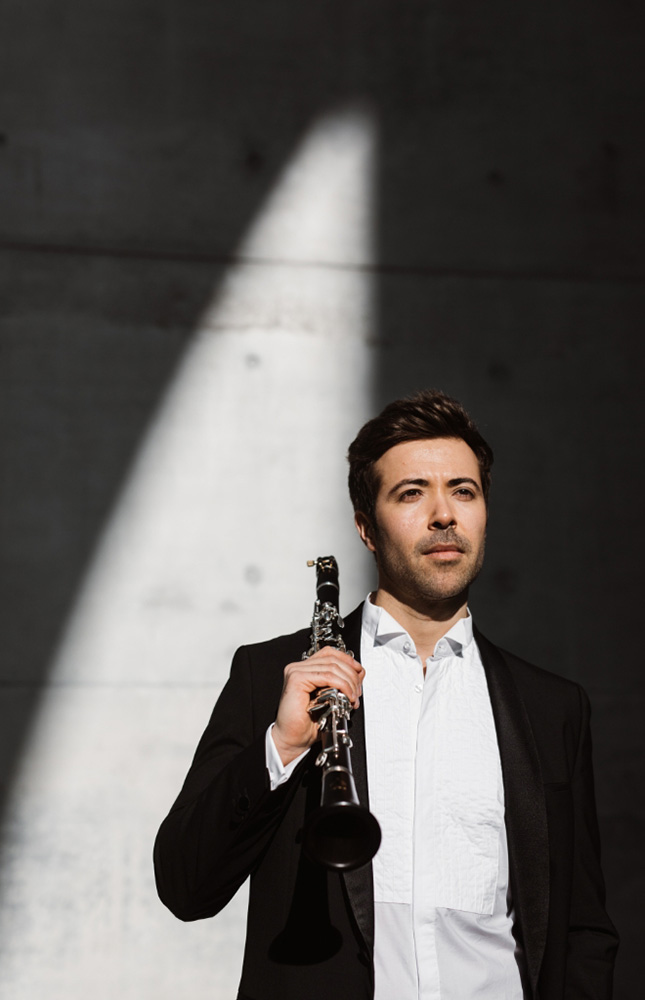
Clarinettist Pablo Barragán is acclaimed for his refined sound, combined with technical perfection, charisma, and inventive programming.
He studied at the Seville Conservatory with Antonio Salguero and later with Matthias Glander at the Fundación Barenboim-Said, also in Seville. In 2013 he became the winner of the Prix Crédit Suisse Jeunes Solistes competition and achieved success in other competitions as well.
He has collaborated with orchestras such as the Brucknerhaus Orchester Linz, Barcelona Symphony Orchestra, Hamburg Symphony Orchestra, Orquesta Sinfónica de Radio Televisión Española, Slovak Philharmonic, and with conductors including Anja Bihlmaier, Thomas Dausgaard, Daniel Raiskin, and Zsolt Hamar.
He is one of the most sought-after clarinettists and chamber musicians. He regularly has the privilege of collaborating with outstanding musicians such as Elena Bashkirova, Beatrice Rana, Kian Soltani, Juliana Avdeeva, Emmanuel Pahud, the Modigliani Quartet, Sitkovetsky Trio, Cremona Quartet, and Schumann Quartet. He has appeared in chamber concerts at the Elbphilharmonie Hamburg, Philharmonie Köln, Konzerthaus Dortmund, the Rheingau Musik Festival, Martha Argerich Festival, Wigmore Hall London, and Tonhalle Zurich.
He opened the 2025/26 season with two clarinet concertos (by Hartmann and Mozart) with the Cologne Chamber Orchestra under Christoph Poppen. Further orchestral engagements followed with the Baden-Baden Philharmonic and the Orquesta Sinfónica de Castilla y León under Vasily Petrenko. He is also due to appear with the NFM Leopoldinum Orchestra Wrocław under Michael Collins and with the Ferenc Liszt Chamber Orchestra in South America.
As a sought-after chamber musician, he will appear with the Modigliani Quartet at the Elbphilharmonie Hamburg and Alte Oper Frankfurt, and also with the Jerusalem Chamber Music Festival Ensemble at the Stradivari Festival in Cremona and in Maribor. In connection with his latest recording, Balagan, which has been warmly received by international music critics, he will appear at the Brucknerhaus in Linz, Lugano Arts Centre, and Wigmore Hall in London together with Noa Wildschut and Amadeus Wiesensee.
His curiosity and creative spirit are also reflected in two recently released recordings, Szinergia and Balagan. Balagan, released in July 2024 on the Accentus label, focuses on works by 20th-century Jewish composers, including Paul Schoenfield, Ernest Bloch, Claude Vivier, and Darius Milhaud. Szinergia, released in October 2024, presents Barragán’s first recording with a chamber orchestra, in this case the Ferenc Liszt Chamber Orchestra. The CD includes Hartmann’s Chamber Concerto and exciting arrangements of Bartók’s Romanian Dances, Weiner’s Divertimento, Kodály’s Double Dance, and Paco de Lucía’s Callejón del Muro.
Since 2020 he has taught at the Barenboim-Said Academy in Seville and taken part in masterclasses such as those at the Escuela Superior de Música Reina Sofía in Madrid. He is also an ambassador for Buffet Crampons clarinets and plays an RC Prestige instrument.
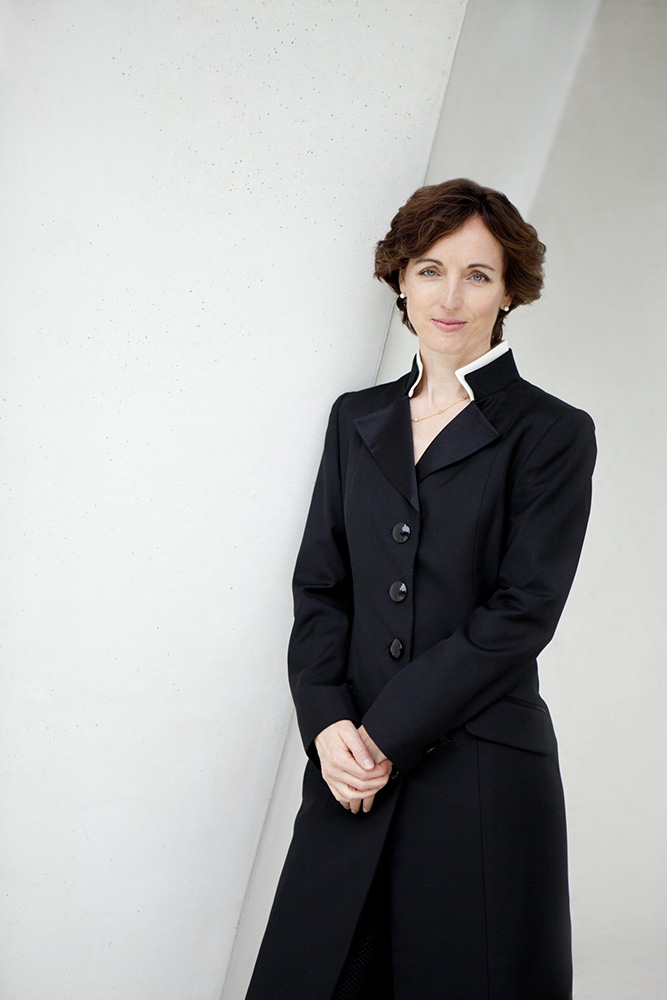
Canadian conductor Tania Miller is known as a dynamic interpreter, musician, and innovator. On stage she radiates authority, energy, and a pure love of music-making. As one critic put it: “…she conveys a calm intensity… expressive, colourful and full of life… her experience and charisma are clearly audible.” Others have described her performances as “technically flawless, vivid and compelling.”
She is Artistic Director of the Brott Music Festival in Canada, as well as Artistic Director and conductor of Canada’s National Academy Orchestra and Brott Opera. She recently made her debut with the National Symphony Orchestra of Mexico and has concerts planned with the Xalapa Symphony Orchestra of Mexico and the Madison Symphony; she will also appear with the Eugene Symphony, Winnipeg Symphony, and South Bend Symphony. She also conducted a production of Mozart’s The Magic Flute at Vancouver Opera and, in 2024, a concert with the acclaimed soprano Sondra Radvanovsky and the orchestra of Vancouver Opera West. Other recent debuts include concerts with the Warsaw Philharmonic, I Musici de Montréal, Baton Rouge Symphony, and New Haven Symphony.
In addition, she has conducted the KBS Symphony in Seoul and the Virtuoso Chamber Orchestra at the World Orchestra Festival in Daegu, South Korea, with concerts in Daegu, Hwaseong, and Seoul. She has appeared as a guest conductor in Canada, the United States, and Europe with such orchestras as the Bern Symphony Orchestra, NFM Wrocław Philharmonic, Toronto Symphony Orchestra, Seattle Symphony, Chicago Symphony Orchestra, Oregon Symphony, Chautauqua Symphony Orchestra, the National Arts Centre Orchestra in Ottawa, Orchestre Métropolitain de Montréal, Vancouver Symphony Orchestra, Quebec Symphony Orchestra, Naples Philharmonic, Hartford Symphony Orchestra, Madison Symphony Orchestra, Calgary Philharmonic, Rhode Island Philharmonic, Louisiana Philharmonic, and many others. She served for 14 years as Music Director of the Victoria Symphony in Canada and was subsequently named Music Director Emerita. She has distinguished herself as a visionary and innovator with a strong connection to contemporary composers.
She has also made a notable mark in opera through many successful productions. She has conducted, for example, Lehár’s The Merry Widow at Calgary Opera and a number of operatic productions as Artistic Director of Michigan Opera Works and guest conductor of Opera McGill in Montreal. For four seasons she was Assistant Conductor of the Carmel Bach Festival, and from 2000 to 2004 Assistant and Associate Conductor of the Vancouver Symphony Orchestra. She was assistant conductor for the operatic production of Michael Daugherty’s Jackie O., presented at the Banff Summer Arts Festival. She holds doctoral and master’s degrees in conducting from the University of Michigan. She has received an honorary degree from Royal Roads University and an honorary diploma from the Royal Conservatory of Music in Canada. In 2017 she received the Friends of Canadian Music Award from the Canadian League of Composers for her commitment.
(text: Ondřej Pivoda)

Made by