E3 Young Soloists II
The concert will offer a varied program full of virtuosity and poetry. Ravel’s Rhapsody Gypsy, inspired by Romani music, is a celebration of violin brilliance. Frank Proto’s Nine Variations on Paganini for double bass and orchestra combines a famous theme with jazz lightness. Debussy’s Afternoon of a Faun will transport the listener to a dreamlike world of impressionistic moods. The finale will be the lyrical but technically demanding Violin Concerto by Samuel Barber.
PROGRAM
Maurice Ravel
Tzigane, concert rhapsody for violin and orchestra, M. 76a (10′)
Frank Proto
Nine Variations on Paganini for double bass and orchestra (20′)
/Intermission/
Claude Debussy
Prélude à l’après-midi d’un faune (Prelude to the Afternoon of a Faun), L. 86 (10′)
Samuel Barber
Concerto for Violin and Orchestra, Op. 14 (23′)
Allegro
Andante
Presto in moto perpetuo
PERFORMERS
David Hernych – violin
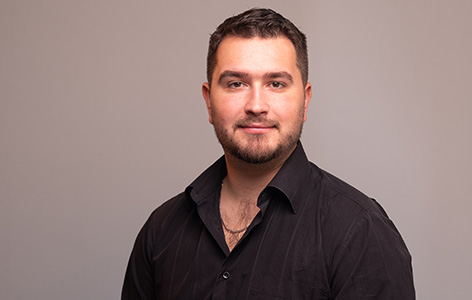
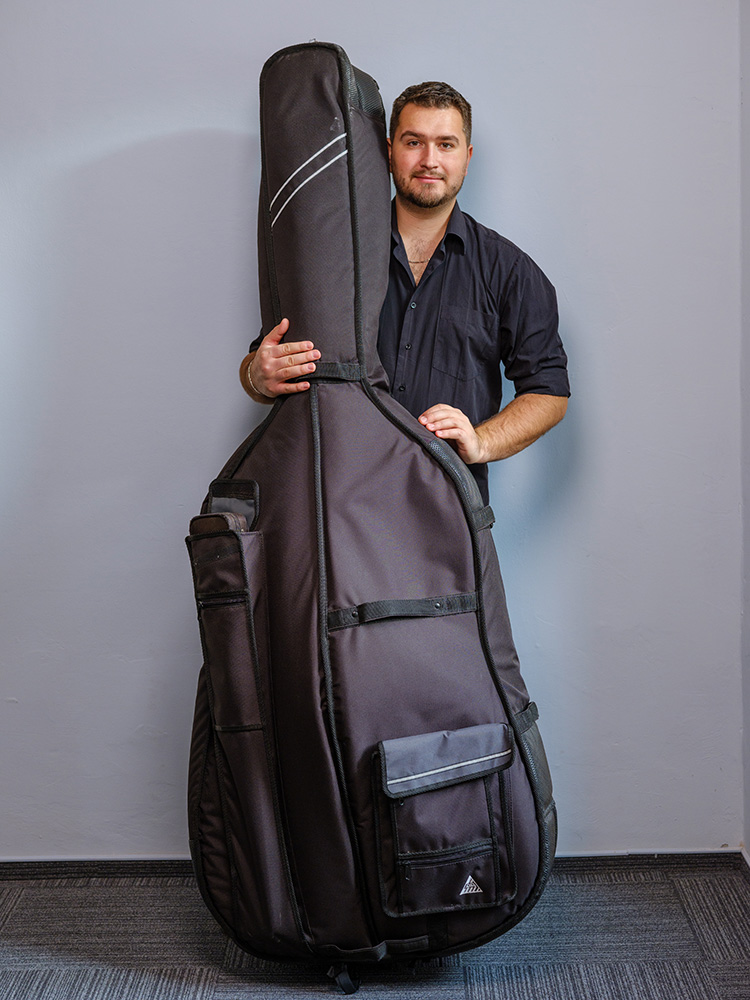
Ondřej Sejkora – double bass
Jiří Vodička – violin, artistic guarantor of the series
Anna Bangoura – presenter
Janáček Philharmonic Ostrava
Robert Kružík – conductor
Both French composers whose works will be heard today—Claude Debussy (1862–1918) and Maurice Ravel (1875–1932)—represent musical tendencies reacting to artistic and literary movements that opposed academic Romanticism at the end of the 19th century, especially Impressionism and Symbolism. While studying non-European, particularly Asian music, from which musical impressionists drew inspiration for experimenting with freer form and harmony, Maurice Ravel also expanded his interests to distinctive European musical traditions. Alongside the music of the Iberian Peninsula, to which he felt close due to his partly Basque origin, he also explored the music of Hungarian Romani ensembles. He became more intimately acquainted with it through the famous Hungarian-born violinist Jelly d’Arányi, who played examples for him at a party following a private performance of his Sonata for Violin and Cello in London. Captivated by her playing, Ravel decided in 1924 to compose for her the concert rhapsody Tzigane in this spirit. The work was also conceived as a tribute to great Romantic violin virtuosos, above all Pablo de Sarasate, whose most famous compositions include Zigeunerweisen, Op. 20, on a similar theme.
In its original version, Ravel’s piece featured violin accompanied by the luthéal, an attachment for the piano invented in 1919 by Belgian Georges Cloetens. Its sound resembles the cimbalom typical of Romani ensembles. Ravel soon arranged the accompaniment for orchestra. The composition follows the two-part structure typical of a csárdás: after a slow, darkly melancholic lassan of improvisatory character performed by the solo violin without accompaniment, a passionate and continuously intensifying friska follows, full of brilliant virtuoso passages. Although Ravel sought to emulate the virtuoso style of the 19th century, the work unmistakably bears the color and harmonic richness of an impressionist master.
Ravel’s older contemporary Claude Debussy was often inspired in his compositions by the literary works of his contemporaries, especially the Symbolist poets. One of them was Stéphane Mallarmé, who provided the basis for Debussy’s epoch-making Prelude to the Afternoon of a Faun (1892–1894). Mallarmé had a deep interest in music and was a friend of Debussy. When planning a staged reading of his extensive eclogue Afternoon of a Faun, he asked Debussy to compose accompanying music. The plan was never realized. However, Mallarmé’s monologue of a faun reflecting on his amorous experiences—finding fulfillment in his own imagination—ultimately inspired Debussy to compose an orchestral prelude.
This truly impressionistic work, freely translating the poem’s atmosphere into music, marks a new chapter both in Debussy’s own output, previously more traditionally oriented, and in the development of European symphonic music in general. Although its loosened form, unexpected shifts in mood, and rich coloration may give the impression of improvisation, Debussy achieves cohesion through skillful and often unconventional compositional techniques. The opening ethereal flute solo, with its chromatic motion, evokes the faun meditating while playing his panpipes. Subsequent harp glissandi, with refined accompaniment from woodwinds and horns, create a mysterious, almost fairy-tale atmosphere. The flute theme then permeates the work in constant variation. As the faun’s dream unfolds, tension gradually builds through the melodic arcs of the strings, reaching a peak of ecstasy before subsiding in a descending theme in the winds. The flute returns once more, bringing the piece to a quiet, dreamlike close.
Samuel Barber (1910–1981) and Frank Proto (*1941) rank among the most significant figures of 20th-century American music. While Barber was primarily a composer (though he occasionally conducted his own works and briefly pursued a career as a concert singer), Proto originally approached composition as a complement to his career as a double bassist. His interest in composing arose during his studies due to the lack of quality original repertoire for his instrument. His Sonata for Double Bass and Piano (1963) became one of the most frequently performed works for double bass in the 20th century. He soon established himself as a distinctive and respected composer.
Proto has devoted himself as a performer to both classical music and jazz throughout his life, and his compositional output also bridges these two worlds, as evident in Nine Variations on Paganini (2001), written for French double bass virtuoso François Rabbath. The variations are based on the famous theme used by Niccolò Paganini (1782–1840) in the final caprice of his set of 24 Caprices for solo violin, where he most fully demonstrated his extravagant virtuosity. Proto explores hidden possibilities of this melody, placing it in unexpected harmonic and rhythmic contexts while transferring Paganinian virtuosity to the double bass. The work incorporates not only jazz elements but also rhythms of Latin American dances, especially salsa.
Samuel Barber remained faithful in his work to the legacy of 19th-century music, classical forms, and traditional harmony, incorporating modernist elements only cautiously. His works are typically characterized by lyricism and a nearly Romantic expressiveness. These qualities are also present in his Violin Concerto, Op. 14, composed in 1939 for Philadelphia industrialist Samuel Simeon Fels and his adopted son, Italian violinist Iso Briselli.
The concerto had a complicated path to its premiere. Briselli was dissatisfied with the solo part: he found it insufficiently virtuosic in the first two movements and intended to revise it himself, while rejecting the third movement entirely, even though Barber had written it in response to his earlier comments. The concerto was eventually premiered in 1941 by the legendary American violinist Albert Spalding.
Although Barber draws on the Romantic concerto tradition, the solo instrument does not assume the role of a heroic protagonist but instead engages in an intimate, emotionally profound dialogue with the orchestra. The chamber-like accompaniment is enhanced by the inclusion of piano in the orchestra. The first movement opens with the soloist presenting the main lyrical theme, contrasted by a more lively and playful secondary theme, mainly in the winds. Melancholic passages alternate with more exalted ones, leading to a subdued, nostalgically colored conclusion. The slow middle movement is built on two contrasting ideas—a tender oboe cantilena and a darker, rhapsodic song of the solo violin. The finale is an energetic and brilliant conclusion, whose motoric passages give the soloist space to demonstrate technical mastery.
(Vlastimil Tichý)

Made by