A shuttle service will be provided between the entrance to the Hukvaldy Game Reserve and Hukvaldy Castle.
| 27. 06. 2026 15:30 p.m. |
| 90 minut |
| Hrad Hukvaldy |
| 89 volných míst |
| from 300 CZK |
| festival |
Janáček at Hukvaldy Castle
Janáček’s Říkadla are small, mischievous pieces that the composer was inspired to compose in early 1925 by Lidové noviny.
In case of adverse weather conditions, the concert will take place at the Leoš Janáček Primary and Nursery School.
Leoš Janáček
Říkadla (Nursery Rhymes), JW V/16
Gideon Klein
String Trio
Steve Reich:
Tehilim
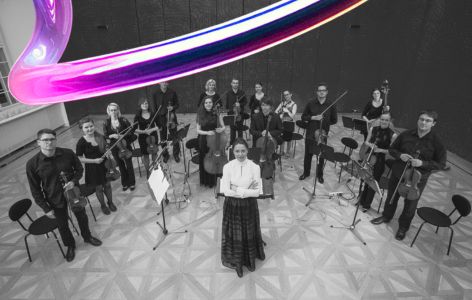
Ensemble Opera Diversa
Gabriela Tardonová– conductor
Janáček’s Říkadla are short, playful pieces whose composition was inspired in early 1925 by the newspaper Lidové noviny. At the time, Janáček was deeply engaged in work on his opera The Makropulos Case when he wrote to his friend Max Brod that “children’s nursery rhymes with melodic and harmonic somersaults were creeping into my fingers at the pen.” The newspaper was publishing short rhymes taken from the famous collection of Czech folk songs and nursery rhymes by Karel Jaromír Erben, accompanied by illustrations by artists such as Josef Lada, Ondřej Sekora, and Jan Hála. In the expanded 1926 version for nine voices and a ten-member chamber ensemble, Říkadla sparkle with wit and childlike, sincere playfulness.
Janáček’s music was a major source of inspiration for composer Gideon Klein, a Czech Jewish pianist and composer who perished at the age of just twenty-five after years of suffering in Nazi concentration camps. Klein’s String Trio was composed in Terezín in 1944, shortly before his deportation to Auschwitz. The trio’s modern and powerful music grows out of the roots of Moravian folk tradition and stands as a deeply moving expression of the composer’s longing for home.
Leading American composer and one of the most prominent figures of musical minimalism, Steve Reich, reflects his relationship to Judaism in his work Tehilim. The title of the 1981 composition comes from the Hebrew word for Psalms, whose texts Reich sets to music in this piece. Reich’s minimalist musical language here draws both on Baroque counterpoint and on elements outside the Western classical tradition. In his work with speech melody, Reich was also inspired by the music of Leoš Janáček and his concept of speech-melody.

Made by