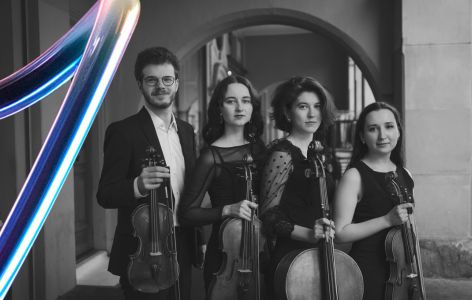
Leoš Janáček and Antonín Dvořák were united not only by their love of music, but also by a deep and genuine lifelong friendship. Their most important quartet works will be performed by young string ensembles that have succeeded in competing in prestigious competitions.
Leoš Janáček
Quartet for Two Violins, Viola and Cello “Intimate Letters”, JW VII/13
Antonín Dvořák
String Quartet No. 14 in A-flat major, Op. 105, B 193
Arola Quartet (laureates of the Leoš Janáček International Music Competition Brno 2025)
Samuel Nathan Hirsch, Alla Ternova– violin
Viktoriia Vanteeva– viola
Zoia Sudnis– cello
Kubitovo Quartet (laureates of the Kroměříž Summer Academy)
Filip Kubita, Kateřina Vítečková– violin
Michaela Sedláčková– viola
Petr Hamerský– cello
Leoš Janáček and Antonín Dvořák were united not only by their love of music, but also by a deep and genuine lifelong friendship. Their most significant string quartet works will be heard here in performances by young string ensembles that have distinguished themselves in prestigious international competitions.
Janáček’s Quartet for Two Violins, Viola and Cello Intimate Letters was composed in the final year of the composer’s life and reflects his deeply personal and affectionate relationship with his muse Kamila Stösslová. These musically rendered “love letters,” as the quartet was originally titled, offer an intimate glimpse into the composer’s inner world, which speaks directly to the listener through Janáček’s aphoristic musical language. Janáček did not live to see the premiere, which took place in Brno in September 1928. Yet the inner power of this artistic confession has secured the work’s position as one of the most important contributions to the string quartet repertoire of the 20th century.
Dvořák’s String Quartet No. 14 in A-flat major, Op. 105 also belongs to the composer’s late works. He began composing it in New York and completed it only after returning from his American stay to Bohemia in December 1895. In this quartet, Dvořák brought his compositional mastery to full fruition, filling the four movements with lyrical and joyful music that reflects his happiness at returning home and being reunited with his children and family.