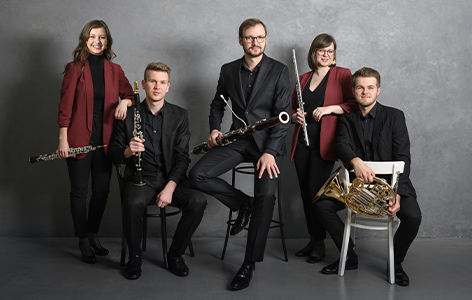
K4 Alinde Quintet
The young Czech ensemble Alinde Quintet, laureate of the prestigious Munich ARD competition, will present a varied program of Czech and Nordic composers in Ostrava. The program will include Rejch’s fresh Wind Quintet Op. 100, Pavel Haas’s playful and uniquely styled Quintet, the meditative and deeply felt Music for a Deceased Friend by Latvian composer Pēteris Vasks, and the French-charm-inspired Serenade “Playing in the Forest” by Danish composer Jørgen Jersild.
The concert will take place under the patronage of Vilmārs Heniņš, Ambassador of the Republic of Latvia to the Czech Republic.
PROGRAMME
Antonín Reicha
Wind Quintet in F major, Op. 100, No. 1 (37’)
Lento, Allegro con brio
Adagio
Minuet: Allegro vivo
Finale: Allegro poco vivo
Pavel Haas
Wind Quintet (14’)
Preludio: Andante ma vivace
Preghiera: Misterioso e triste
Ballo eccentrico: Ritmo marcato
Epilogo: Maestoso
/Interval/
Pēteris Vasks
Music for a Deceased Friend (10’)
Jørgen Jersild
Serenade “At Play in the Forest” (15’)
Giocoso
Andantino pastorale
Vivo
PERFORMERS
Alinde Quintet
Anna Talácková, flute
Barbora Trnčíková, oboe
David Šimeček, clarinet
Kryštof Koska, French horn
Petr Sedlák, bassoon
Antonín Reicha (1770–1836) is one of the leading figures of Czech musical emigration at the turn of the 18th and 19th centuries. At the age of eleven, due to difficult family circumstances, he left his mother and stepfather and moved from Prague to his grandfather in Klatovy. From there, he went to live with his uncle Josef Reicha, who worked as a cellist in aristocratic service in Swabia. Soon afterwards, they both moved to Bonn, where Antonín played in the Elector’s chapel and in the theatre orchestra. He studied at the university there and, through private study, also acquired a knowledge of compositional theory. After a brief period in Hamburg, he settled in Vienna from 1799 to 1808. Eventually, however, Paris became Reicha’s home, and it was there that his compositional mastery reached its full maturity. He was appointed professor at the Conservatoire, and as a composer, teacher and theorist he received significant social honours.
While still in Bonn, he became friends with Beethoven; in Vienna he studied with Haydn and met Salieri. His pupils in Paris included Berlioz, Franck, Liszt and many others. Stylistically, Reicha represents the transition from Classicism to the expressive means of Romanticism. In his theoretical writings, he approached the issues of musical declamation, harmony, melody, polyphony and musical form in an innovative way. He attempted to compose operas, writing eight of them, including Sapho, but he became better known as the author of chamber works, especially wind quintets, which are the focus of the greatest interest among today’s performers. Indeed, it was Antonín Reicha who played a decisive role in establishing the standard formation of the wind quintet as we know it today. The Wind Quintet in F major is the first piece in his jubilee Op. 100, which contains a total of six compositions for this ensemble. It was written during the composer’s Paris period in 1820. It is a light and elegant four movement work, composed in the form of a freely conceived cyclic sonata structure with an obligatory minuet in the second part.
The talented composer Pavel Haas (1899–1944), a pupil of Leoš Janáček’s master composition class, grew up together with his brother Hugo, the famous Czech actor and later an important Hollywood director, in a Jewish family in Brno. In the Moravian capital, he took an active part in musical life during the interwar period, worked as a répétiteur in the theatre, wrote reviews and composed, among other things, music for films and stage productions. In 1935, he married the physician Soňa Jakobsonová, who divorced the prominent Russian philologist Roman Jakobson because of him; at that time, Jakobson was working at Brno University. While his brother Hugo managed to flee to the United States shortly after the establishment of the Protectorate of Bohemia and Moravia, Pavel did not obtain the necessary documents in time and therefore had to remain in Brno. He took care of Hugo’s son Ivan and formally divorced Soňa, with whom he had a daughter, Olga, in order to spare her and the children the fate that threatened members of Jewish families during the war. In December 1941, Pavel Haas was interned in the Terezín camp, where he became involved in the local cultural life, which was unusually rich for a concentration camp, and continued composing. In October 1944, mass transports from Terezín to Auschwitz began, and Haas was among those deported. Immediately after his arrival at the infamous camp, he was sent to the gas chamber.
Pavel Haas’s compositional legacy is not extensive, but it is extraordinarily remarkable. In his music, he was able to organically combine modern expressive means with Moravian folklore as well as elements of jazz and traditional Jewish music. He wrote the opera The Charlatan to his own libretto and also composed, for example, four string quartets. His vocal cycle Four Songs on Chinese Poetry for low male voice and piano, written in the Terezín ghetto, is also outstanding. In 1929, at a happy period of his life, he also tried his hand at composing a Wind Quintet. The piece is very fresh and modern in expression. At times it has an oriental flavour, while the use of modal keys evokes the folk music of the composer’s native Moravia.
Pēteris Vasks (born 1946) comes from the western Latvian town of Aizpute. His professional life is connected not only with his homeland but also with neighbouring Lithuania. He graduated from the Lithuanian Academy of Music in Vilnius, where he trained as a double bassist, and later studied composition with Valentin Utkin at the Latvian Academy of Music in Riga from 1973 to 1978. For more than ten years he worked as an orchestral musician, playing with the Lithuanian Philharmonic, the Latvian Chamber Philharmonic and the Orchestra of Lithuanian Radio and Television. He has received the Latvian Great Music Award several times for his compositions, including Litene in 1993, the Violin Concerto “Distant Light” in 1998 and the Second Symphony in 2000, as well as many other awards both at home and abroad. In 1996, he was named featured composer at the Stockholm New Music Festival. He is also an honorary member of the Latvian Academy of Sciences and the Royal Swedish Academy of Music.
As a composer, Vasks did not accept the Soviet cultural doctrine and instead chose to build upon the legacy of earlier Latvian composers. Ancient Baltic folklore also plays an important role in his music, which he presents in new aesthetic contexts. In his programme works, he often draws inspiration from Latvian history, his own life and the relationship between humanity and nature. It was only after the collapse of the Soviet Union that Pēteris Vasks began writing symphonies; in the three works he has composed in this genre, he responded to the political emancipation of the Baltic states. He is also the author of two violin concertos and one cello concerto. He frequently turns his attention to chamber and choral music as well.
His wind quintet Music for a Deceased Friend was written in 1982 and is dedicated to the memory of the bassoonist Jana Barinská, who died tragically. It is a single movement, expressive work without a pronounced tonal centre, inspired by Latvian funeral songs. A distinctive feature of the piece is the prescribed singing by the musicians, which is heard at the beginning and again towards the end of the work.
Jørgen Jersild (1913–2004) was a Danish composer and music teacher. He made his first attempts at composition already in childhood. In 1936, he went to Paris, where for three months he became a pupil of the sought after teacher Albert Roussel, with whom he improved above all his orchestration. He then returned to his native Copenhagen and studied musicology at the local university. After graduating in 1940, he devoted his life mainly to teaching music. He taught ear training, composition and instrumentation at the Royal Danish Academy of Music in Copenhagen, while also dedicating himself to the musical education of schoolchildren. From 1949 to 1953, he served as chairman of the Danish Association of Music Pedagogues and wrote several music textbooks.
As a composer, he drew primarily on the achievements of Neoclassicism and Impressionism and rejected the experimental compositional techniques of his time. He wrote mainly chamber music for a wide range of instrumental and vocal ensembles and is also the author of the musical fairy tale Alice in Wonderland (1950), based on Lewis Carroll’s legendary book. He composed his serenade for wind quintet At Play in the Forest in 1946. Its title is an allusion to the song Singing in the Forest by the 18th century German composer Johann Abraham Peter Schulz. Jersild’s musical rendezvous places considerable demands on the performers’ technical mastery and ensemble playing, especially in its third movement, which is marked in a fast tempo. The Serenade, which holds an honoured place among Danish wind quintets, was first performed publicly by members of the Royal Danish Orchestra on 15 February 1947 in Copenhagen.
(Text: Petr Ch. Kalina)
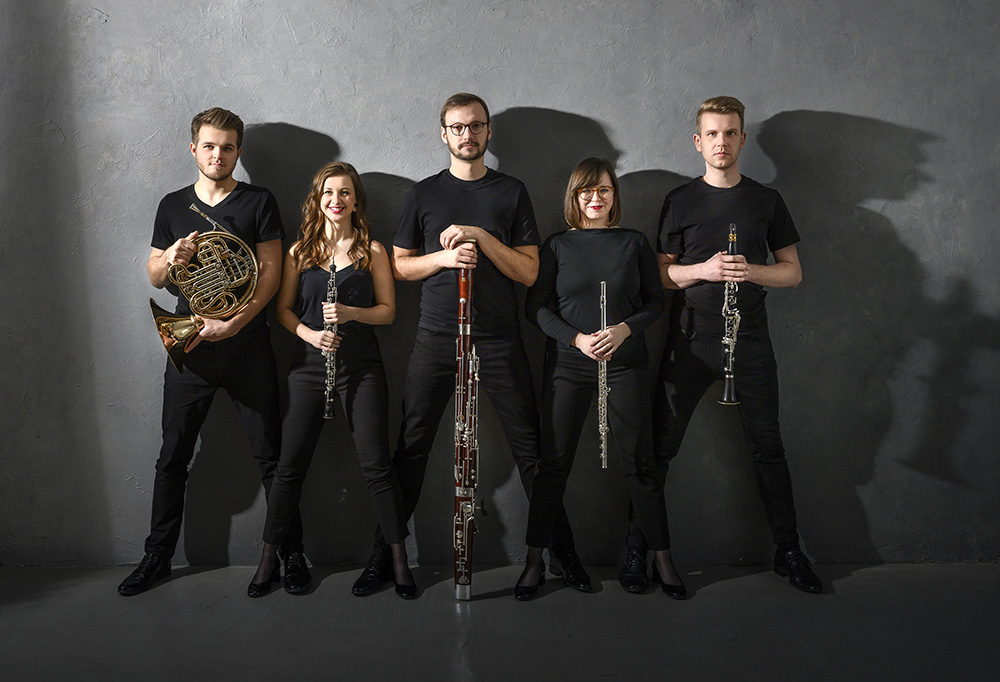
Alinde Quintet is the winner of the ARD International Music Competition in Munich. The ensemble has achieved phenomenal success within a short period of its existence. It was founded in 2019 by leading representatives of the young generation of performers. Its members are Anna Talácková (flute), Barbora Trnčíková (oboe), David Šimeček (clarinet), Kryštof Koska (French horn) and Petr Sedlák (bassoon), graduates of prestigious universities in London, Brussels, Ljubljana, Lyon and Brno, whose paths crossed at the right moment in Prague.
The ensemble has confirmed its exceptional quality throughout its career by winning numerous international competitions, including the Bucharest International Wind Quintet Competition 2019, the ODIN International Chamber Music Competition 2020, the OPUS International Chamber Music Competition 2021 and the Antonín Dvořák Competition Showcase in Prague in 2022. A major success was the 3rd Prize at the Carl Nielsen International Chamber Music Competition in Copenhagen in 2023, followed by participation in the final of the ROSL competition in London in 2024.
Thanks to its membership on the List of Young Artists of the Czech Music Fund Foundation, Alinde Quintet performs regularly on concert stages throughout the Czech Republic. The ensemble has made appearances at the Prague Spring Festival, Newbury Festival in the United Kingdom, Chiltern Arts in the United Kingdom, Festival Krumlov and Smetana’s Litomyšl. In 2024, as part of the Lípa Musica Festival, it presented the exclusive premiere of Antonín Dvořák’s Biblical Songs in an arrangement for wind quintet and bass baritone, with Adam Plachetka.
The members of the ensemble hold principal positions in leading Czech orchestras, including the Czech Philharmonic, the Orchestra of the National Theatre in Prague and the Prague Symphony Orchestra FOK. They also perform with the Czech Radio Symphony Orchestra and the PKF, Prague Philharmonia. In the past, they gained orchestral experience in renowned youth orchestras such as the Gustav Mahler Jugendorchester and the European Union Youth Orchestra.
As soloists, they have received awards in many international and national competitions, including the Prague Spring International Music Competition, the International Competition in Chieri, the Pro Bohemia Ostrava International Competition, the Žestě Brno International Competition and Czech Clarinet Art.
The quintet is currently preparing the release of its debut album.

Made by