Artist in Residence Alena Baeva to Perform Brahms’s Violin Concerto in D Major
One of the central figures of the Janáček Philharmonic Ostrava’s new concert season is its artist in residence, violinist Alena Baeva. In September, she will appear at two inaugural concerts with the orchestra’s Chief Conductor Daniel Raiskin, performing Brahms’s Violin Concerto in D major, one of the pinnacles of the violin repertoire. She will return to Ostrava in January with pianist Vadym Kholodenko for a chamber programme featuring music by Beethoven, Adès, Britten and Prokofiev.
In this interview, she speaks about her relationship with the Janáček Philharmonic and its Ostrava audience, returning to the great masterpieces, finding her own interpretation, and sharing both her musical and personal life with Vadym Kholodenko.
You are returning to Ostrava, this time as the JFO’s artist in residence. What does this return mean to you?
I am very happy to be able to perform in Ostrava again and to make music with these particular musicians. You have a wonderful orchestra. It was truly remarkable for me to discover such enthusiasm within this group, such a commitment to achieving the highest possible quality of playing, and such immense joy in making music together. These are the values that matter most to me.
Being invited to return to Ostrava as artist in residence is therefore an honour. The fact that we can continue developing our relationship is also very valuable to me, because in the past it often happened that I would arrive, perform one, two or three concerts, and that would be it. Then I would move on to another orchestra. Of course, that is fascinating too, but you can only explore more deeply what you are truly capable of achieving together when you spend a longer period of time working with one another. I am very much looking forward to that.
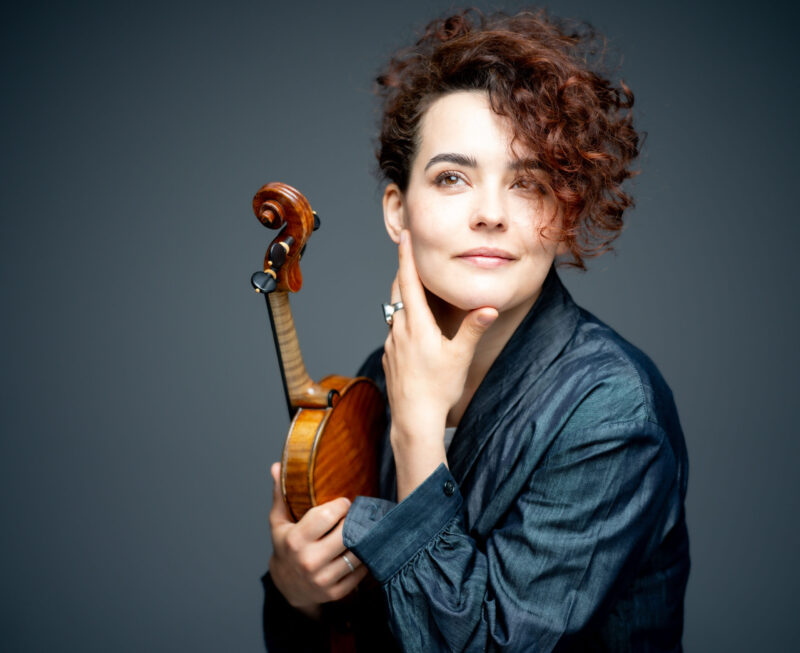
Alena Baeva violin
photo: Marco Borggreve
Do you remember your first concert with the Janáček Philharmonic?
Yes.
What impression did the orchestra and the audience make on you at the time?
They fascinated me, actually. I did not know what to expect. I had not anticipated playing of such a high standard or such a knowledgeable and eager audience. Naturally, that requires years and years of building a relationship between the orchestra and its audience, as well as carefully considered programming and genuine attention to every detail.
It is about creating programmes that are educational and entertaining at the same time, allowing listeners to discover all the different forms and possibilities that music can offer. It is clear that an enormous amount of work has been done behind the scenes, because the result is truly impressive.
When you perform with an orchestra you know well, does it change your approach to interpretation? Does it give you greater freedom, or rather a greater sense of responsibility?
It is always a responsibility, of course. But at the same time, there is greater freedom as well. It is like talking to an old and trusted friend. With some people, conversation is very easy and pleasant. You can talk about absolutely anything, from profound subjects to very personal matters. But when you speak with an old friend, it is something different again. There are so many layers to it.
It is similar with all the works we perform together with the Janáček Philharmonic. They gradually shape our relationship too, and I am very, very grateful for that. We performed Béla Bartók’s Second Violin Concerto together with conductor Dmitri Jurowski, and then Johannes Brahms with Lionel Bringuier. It was wonderful, and those experiences remain part of our relationship. Now I am very much looking forward to returning, building on what we have already experienced together, and beginning rehearsals on a new work.
What is your starting point when you begin learning a new piece?
For me, the score is the most important thing. I do not listen to recordings, because I want to form my own view of the piece I am going to perform. The score is absolutely essential for that, because it is a message from the composer. Everything is there, and everything begins with it.
This is especially true when you understand the composer’s language. I know the music of Beethoven, Mendelssohn, Mozart and all these great composers very well, but each of them is distinctive. Each works with their own musical language. I consider the ability to understand that language and translate it into an interpretation to be fundamental.
An interpretation is always personal, and that is how it should be. It should never be merely a dull and mechanical reproduction. When I am working on a piece, it is also important for me to understand how the composer lived. That is why I greatly enjoy reading letters, biographies, books about composers and academic research.
Are there works to which you return again and again because they give you a sense of stability and certainty?
Definitely. We violinists are very fortunate, because we have an enormous repertoire at our disposal. I also enjoy performing chamber music, but most often I play violin concertos, and that is a very extensive repertoire.
Brahms, however, wrote only one violin concerto. Beethoven also wrote only one, whereas he composed five piano concertos. Mozart wrote more than twenty piano concertos, but only five for violin. Naturally, therefore, I return to these masterpieces.
Every time I encounter them again, I am already a different person, and my perception of the music has changed. It is therefore more a process of rediscovery than repetition. It is a very fundamental return to the beginning, which helps clarify why I am doing this, what I want to communicate, and how I can communicate it.
How do you perceive the role of the audience? When you perform, do you feel that the audience also becomes part of this foundation, providing a kind of support for the entire moment?
Yes, very often. In my view, the audience plays a major role. For me personally, it is never a matter of preparing something and then presenting it. As a musician, I always experience it as an interaction.
It is not about watching to see who is reacting. It is more about the atmosphere in the hall. There is an enormous difference in the way different audiences listen.
One of my mentors, the wonderful violinist Robert Mann, founder of the Juilliard String Quartet, once told me: “When you practise, imagine an active listener.” That is a wonderful idea. When you practise at home, even as a child, imagine that someone is listening to you actively and lovingly, truly paying attention to what you are doing. There is always someone like that in the audience, someone who truly understands you.
An artistic career is demanding both physically and mentally. Where do you find personal support when fatigue or pressure begins to set in?
That is a very relevant question at the moment, in the middle of an extremely intensive tour. The past month has been full of demanding tasks and programmes. So, although it may sound trivial, the essential thing is to eat well. And I mean that entirely seriously.
This is something we musicians all share. We all feel it. When we perform, we give everything we have. But what do we actually take back in return? Only food, water and air. During a tour, there is essentially no room for anything else.
When I perform in a different city every day, I consider it a great stroke of luck if I am staying near a museum and can spend an hour or two there. That is the greatest possible cultural bonus. Even so, what I eat remains very important to me.
What else helps you, apart from food?
Sleep and physical activity, of course. I really enjoy walking, especially hiking in the mountains. I love forests and nature. It is all very simple, natural and fundamental. And that is exactly what gives a person strength and energy.
Have you had a close relationship with nature since childhood?
Yes. I remember something from my childhood, when I was about six or seven years old. In the courtyard of the school I attended, there was a small green corner: a little grass, a few trees, nothing large, but simply a small patch of greenery.
I was a very active child and was always running around. Even then, it was quite clear that I had ADHD. Today, I have been diagnosed, and I am actually proud of it. But I loved being able to lie down in the grass, close my eyes and imagine that I was drawing an enormous amount of energy from the earth.
A new concert hall is being built in Ostrava. What do you think should be at its heart in order to create an ideal musical environment?
That is a beautiful question. I believe that the most important thing in Ostrava, the very heart of it, was already present years ago, even before the idea of a new hall emerged. It is the people, who form an extraordinary team.
There are the musicians who play in the orchestra, and then there are the people who attend the concerts. All of this is already highly developed and more than ready to fill the new space and give it a new life. I am so, so excited that I may soon be able to see the result. I have been looking forward to it for several years.
You share your life with the pianist Vadym Kholodenko. What is it like when two powerful musical worlds come together under one roof?
We met as musicians and discovered one another through music. During the first ten years of our relationship, we also grew together primarily as musicians. It has always been an immense joy and privilege to perform with such an exceptional personality and musician.
I have learned a great deal from Vadym as a violinist. We violinists have “only” four strings, so we learn from pianists about harmony, form and structure, while singers teach us many other things. When we eventually realised that we simply could not live without each other, taking the next step felt entirely natural.
Did your life together then influence your musical collaboration as well?
I cannot say that it disrupted our playing together. Just as it was twenty years ago, I still enjoy rehearsing, focusing on details and changing things, even on the day of a concert.
Vadym also likes to rehearse, make adjustments and search for new possibilities, but he prefers to do so well in advance rather than at the last minute. For me, the day of the concert itself is a kind of “laboratory time”, when everything can be reshaped, something new can be discovered, and new paths towards spontaneity can be explored.
The entire piece can be reconsidered once again, and I find that immensely fascinating. Vadym does not feel the same way. That is the moment when a little tension occasionally arises between us.
This may be a silly observation, but it occurred to me that, as a violinist, you take the instrument you know with you to every concert, whereas Vadym encounters a different piano at every venue. He must constantly adapt.
That is an excellent observation. I am certain that it has a major influence as well.
What does a young musician fundamentally need in order to grow while remaining true to themselves?
Remaining true to oneself should be the absolute foundation. Beyond that, everything influences the development of a young musician: the way they live, what they see, and what they think about. In other words, their entire life. And, of course, food as well. (Laughs.)
But seriously, I believe that musicians have a responsibility to communicate something, to share a certain message. It is therefore important to have something meaningful to say and something to draw upon. That does not happen by itself.
A person needs to remain open to the world around them: to be curious, to discover, to search for what feels close to them, to spend time with people in whose company they feel comfortable, and to allow themselves to be influenced by different forms of art.
To me, this is one of the most important foundations. Once a person learns how to perceive and receive, they naturally learn how to give as well.
There is a great deal of discussion today about contemporary music and new works, often written on commission. What brings you the greatest joy in this area?
It gives me immense joy to know that this music will not disappear or be forgotten. The Western tradition of classical music, what we refer to as “the classics”, has been developing for several centuries. It is an extraordinarily valuable heritage, a genuine treasure that continues to nourish generation after generation.
I remember, for example, my son when he was sixteen. He listened to a great deal of music, played the piano and cello a little himself, and had attended concerts from an early age. Then, one day, he heard a Beethoven concerto live for the first time. I will never forget the expression on his face.
He is not professionally involved in classical music, and I never pushed him towards anything. He listens to completely different music from me. And yet everything was perfectly clear from his eyes.
There are simply works that affect a person so powerfully that they cannot be ignored. They draw you in and carry you somewhere else. It gives me immense joy to see a new generation discovering these works for themselves, and to see how music enriches them and makes their lives fuller. That makes me truly happy.

Made by