Interview with Jiří Vodička: The violin and the player? Like a wand and a wizard in Harry Potter
Violin virtuoso and concertmaster Jiří Vodička launched his career at the age of just twelve, when he first performed with the Janáček Philharmonic Ostrava. At fourteen, he was exceptionally admitted to university in Ostrava to study under the renowned teacher Zdeněk Gola. By the age of nineteen, he had earned his master’s degree. Although he later moved to Prague, he says that without Ostrava, he would not be where he is today.
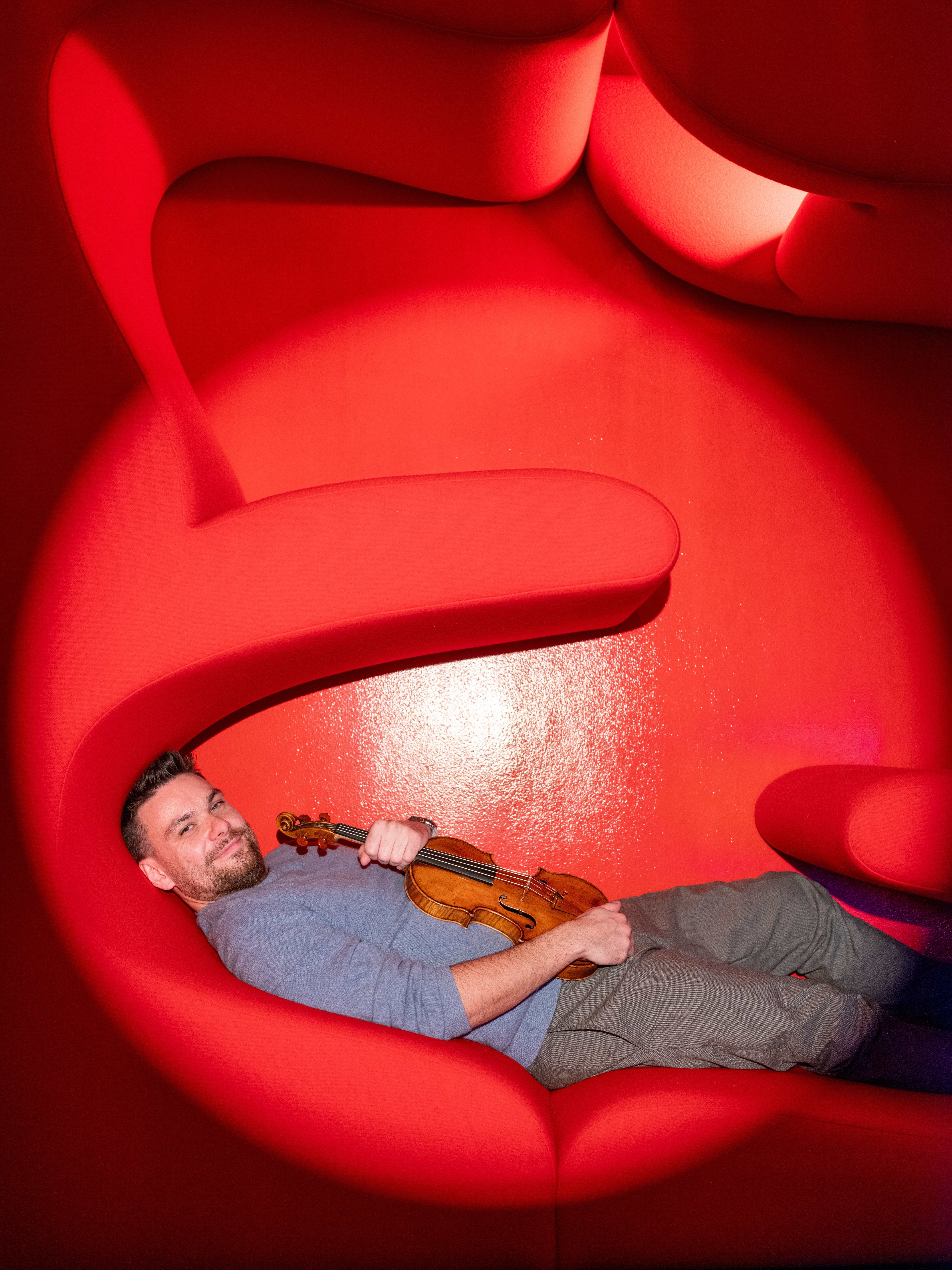
He regularly performs as a soloist with many leading Czech and international orchestras and plays a remarkable violin dating from 1774. What he has been given, he now gladly passes on to his students. This is also why he accepted the offer from the Janáček Philharmonic Ostrava to become the guarantor of Cycle E – The Energy of Young Talent.
We are speaking just a few minutes after the end of a performance competition for young string players, whose winners will perform as soloists in three concerts with the Janáček Philharmonic Ostrava. You were one of the jurors. When someone starts playing in front of you, how quickly can you tell that they are exceptional?
Immediately, we know within a few seconds.
And did anyone truly outstanding appear in today’s competition, someone you already sense could have an excellent career?
I am convinced that some of them have great potential. I have even had the opportunity to teach some of them in the past, so I know well how talented they are. Now it will depend on them which path they choose—whether they pursue a solo career, focus on chamber music, go abroad, or perhaps join one of the major orchestras. When I think back to myself at their age—I was actually even younger—these stage experiences with an orchestra were crucial for me. They helped me gain confidence and gave me the right start for the future.
When you talk about yourself at their age, did you experience any déjà vu today on the jury?
Yes. One young woman played part of Saint-Saëns’s Rondo Capriccioso—the same piece I myself performed here with the Janáček Philharmonic Ostrava. It was my very first appearance with an orchestra. So today, my fellow juror Pavel Doležal, concertmaster of JFO, was looking at me—he accompanied me back then as a twelve-year-old boy. Rondo Capriccioso has accompanied me throughout my life, so hearing it again in this context was truly special.
What was Jiří Vodička like at the age of twelve? Were you nervous?
I was always nervous. And I still am. Of course, it depends on the importance of the concert, the repertoire, and other factors. Naturally, the more often you stand on stage, the less nervous you tend to feel. But even so, there are concerts that are exceptionally demanding—not only in terms of performance. For example, live television broadcasts bring enormous pressure. And the further you progress in your career, the higher the audience’s expectations become.
It almost happened that you could have become a professional dancer.
Yes. In second grade, a classmate slipped a note into my school bag for my mother. It said that a girl wanted to dance and was looking for a partner. And I said absolutely not, because I was terribly shy. But I forgot to throw the note away, my mother found it at home and sent me to try dancing. In the end, it turned into three wonderful years. I really enjoyed it.
Do you think that if you didn’t play the violin, you would have become a dancer?
I think so. Although I’m not sure whether I would have reached a level that would make it worthwhile. I know how tough that environment is—I know dancers and their world. Incidentally, that was one of the reasons I ultimately chose the violin. Music is a lifelong love; I can pursue it actively for much longer.
What is the greatest appreciation an audience can show you?
For me, the reward from a concert is always the same. When, at the end, everyone is smiling—even those who didn’t really want to be there, often men accompanying their partners—you suddenly lose all sense of time. You enter a kind of bubble with the audience, a symbiosis. And that is the greatest reward for me: when my sincere experience in the music resonates with people so strongly that they experience it with me. The most beautiful thing is when someone tells me they had a terrible day but forgot everything during the concert. That means the most to me.
Artist Gabriela Pilařová once told me that when she saw you play, she felt as if the music was flowing directly through your body. What do you experience when you play? You mentioned a bubble—do you stop perceiving everything else?
It depends. We perform music by composers who put their emotions, stories, and the spirit of their time into their works. As performers, we must try to understand all of that, to feel what the music is saying, to grasp it and convey it. My task is to master the instrument so that it expresses what the composer likely intended, while also adding my own individuality. When that happens, I enter that “bubble.” Of course, sometimes your mind is full of other things and you simply have to deliver the piece as professionally as possible. But the most beautiful moment comes when you fully live the music and completely forget about the world around you.
Your father was a rock guitarist. How did that influence you?
A great deal. Because I grew up with rock music, I have a natural connection to it—and as far as I know, I am one of the few classical musicians in this respect. This experience fully came into play when Michal Dvořák from the band Lucie approached me for the project Vivaldianno. It is essentially Vivaldi in an art-rock style. If I were a typical classical violinist, I probably would never have agreed to something like that. But because I grew up with this music, I know that such projects make great sense. It is a way to reach younger audiences and people who do not yet have experience with classical music—and perhaps it is exactly what will draw them in.
Speaking of reaching audiences, I noticed you once performed a New Year’s concert in suspenders.
I try to bring a kind of renaissance in this respect. The tailcoat or tuxedo—the traditional attire—is of course historically tied to classical music. But the world around us has changed. So why not be innovative at least in this aspect, when we are playing music written centuries ago? This also applies to audiences. People come to classical concerts with the feeling that it is a “very serious” event. And that Czech term “serious music” is, in my opinion, very unfortunate. Music itself is not serious—society made it that way. “Serious” started to mean: I don’t understand it, so it must be very serious.
These are exactly the things I try to challenge. I want to show that classical music is alive, playful, emotional—and definitely not something that should intimidate.
You play a violin by Joseph Gagliano from 1774, which was lent to you years ago by Jiří Bělohlávek, and his family continues the loan. I assume the path to such an exceptional instrument was quite difficult.
Absolutely. And I originally thought that with the budget I had available, I would find my instrument quickly. In the end, it took a year and a half, during which I tried perhaps eighty violins. With each one, something essential was missing.
It is simply a process that takes time, and the fact that a particular violin suits me does not mean it would suit someone else. I always say it is like in Harry Potter: every wand must find its wizard. These Gagliano violins were originally supposed to be purchased by J&T Bank, but that did not happen. That is when Jiří Bělohlávek stepped in, recognizing how exceptional the instrument was. He decided to buy it for me because he knew such a violin must not be lost to us. Who else would do something like that? It is a gesture I will never forget.
I know you also had the opportunity to try legendary Stradivarius violins and that you would not exchange them for your own. How did you get such an opportunity?
When I was flying to concerts in New York, an American agency arranged an instrument for me there. I did not know what it would be. I simply went into a shop and tried it. It turned out to be a Stradivarius worth two million dollars. Beautiful, but for me it had issues I would not want. Despite its astronomical value, it did not suit me as well as my own violin. It only confirms that price and prestige are not everything—the most important thing is the connection between the violinist and the instrument.
Violinist Petr Benda also mentioned in an interview that it is almost impossible here to access high-quality instruments. It clearly seems to be a major issue. How much does it limit students in their development?
The problem with many instruments—and I have experienced this countless times, having tried so many—is that once you reach a level where you are better than your instrument, it starts to limit you. It is an incredibly frustrating feeling, because you realise that your technique and skills can no longer develop further because of the instrument.
The moment you get a better violin, it is as if you suddenly blossom. Within a short time, you move up a level. I am convinced that there are many talented people—not only those we heard today, but students in general—whose development is significantly held back by a poor instrument. And that is a great pity.
How do you stay in shape?
Working on mental well-being and overall physical condition is essential. I have found my balance in cycling, specifically trekking, which helps me maintain equilibrium. I also have great memories of dancing—that is exactly what we need. As musicians, we often face enormous demands. Our heart rate can be extremely high even in physically calm situations because it is influenced by emotions. And that is not healthy for the body. Stress, adrenaline, and other factors mean our bodies are constantly under pressure, which is not natural.
To stay balanced and be able to do this work fully, it is essential to find a way to counteract this strain. For me, it is sport; it brings me the calm and balance I need not only for physical but also mental health.
I have heard that the violin is not just an instrument, but also a reflection of the musician’s soul. Do you agree?
I believe that violins also have a soul. When you take any instrument—like my Gagliano violin—and imagine that this master may have made a thousand or two thousand of them, each one will be different. They differ physically and sonically, which is why I compare them to people.
Violins are made of wood—a material that was once alive and, in a way, still is. Wood constantly works, changes, and reacts to time and its surroundings. And with acoustic violins, the older they are, the better and richer their sound becomes.
This uniqueness and vitality convince me that violins truly have their own soul.
Prepared for the 2025/2026 season catalogue of the Janáček Philharmonic Ostrava by Lenka Pastprčáková.

Made by